Lexeme Entries
| Word | Macy | Part of Speech | Source Definition | Created Date | Last Modified | Last Modified By | Dorsey slip | Actions |
|---|---|---|---|---|---|---|---|---|
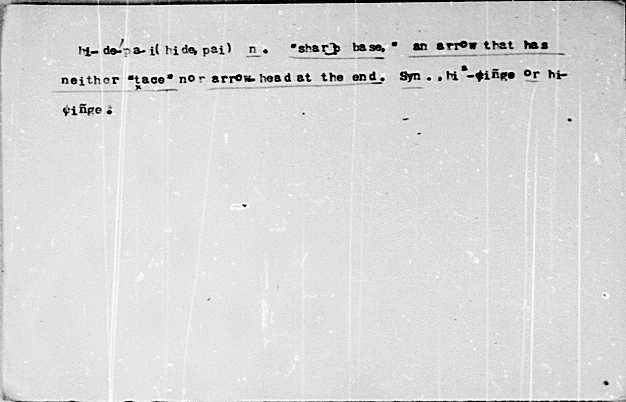
| hi-dé-pa-i | hidépai | n. | "Sharp base," an arrow that has neither "ṭace" nor arrowhead at the end. | 3/25/10 | 7/5/12, 6:18 PM | Catherine Rudin | http://omahalanguage.unl.edu/dictionary_images/hi/opd.02.046.01a.jpg |
View |
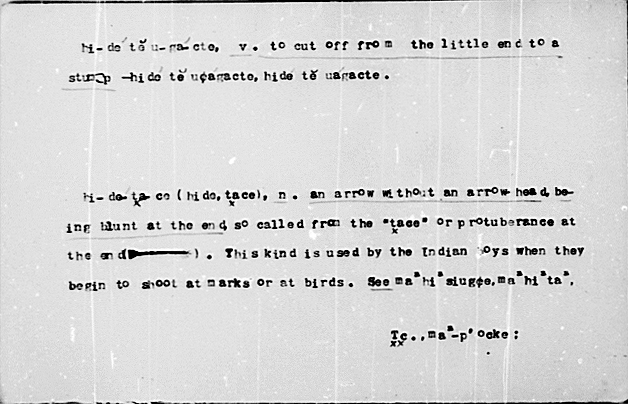
| hi-dé-ṭa-ce | hidétashe | n. | An arrow without an arrow-head, becoming blunt at the end, so called from the "ṭace" or protuberance at the end. | 3/25/10 | 12/22/10, 5:33 PM | Catherine Rudin | http://omahalanguage.unl.edu/dictionary_images/hi/opd.02.046.01c.jpg |
View |
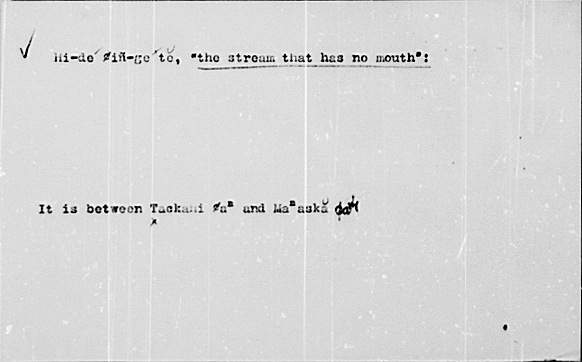
| Hi-dé ȼiñ-gé | Hidé thiⁿgé | prop.noun | "The stream that has no mouth." | 3/25/10 | 5/20/11, 5:08 PM | Catherine Rudin | http://omahalanguage.unl.edu/dictionary_images/hi/opd.02.045.10c.jpg |
View |
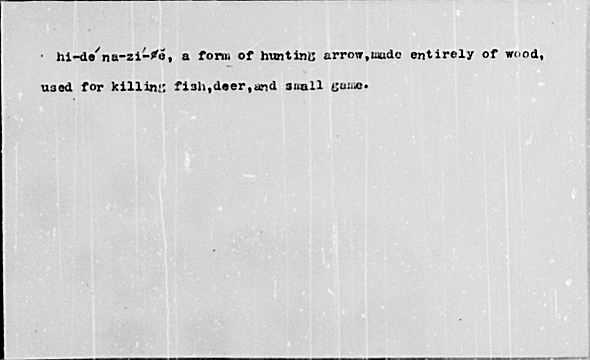
| hi-dé na-zí-ȼĕ | hidé nazíthe | n.phrase | A form of hunting arrow, made entirely of wood, used for killing fish, deer, and small game. | 3/25/10 | 12/22/10, 5:33 PM | Catherine Rudin | http://omahalanguage.unl.edu/dictionary_images/hi/opd.02.045.10d.jpg |
View |
| hi-dé tĕ u-gá-cte | hidé tʰe ugáshte | v.phrase | To cut off from the little end to a stump. | 3/25/10 | 5/22/11, 4:29 PM | Catherine Rudin | http://omahalanguage.unl.edu/dictionary_images/hi/opd.02.046.01c.jpg |
View |
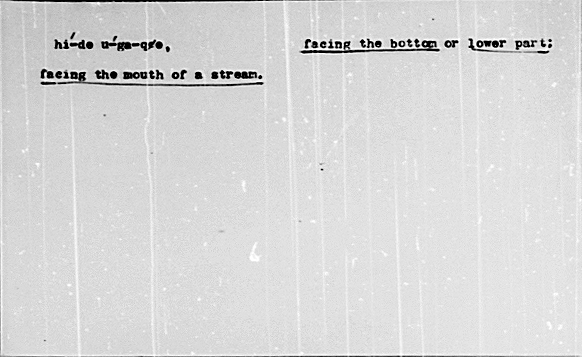
| hí-de ú-ga-qȼe | híde úgaqthe | v.phrase | Facing the bottom or lower part; facing the mouth of a stream. | 3/25/10 | 5/22/11, 4:32 PM | Catherine Rudin | http://omahalanguage.unl.edu/dictionary_images/hi/opd.02.046.01b.jpg |
View |
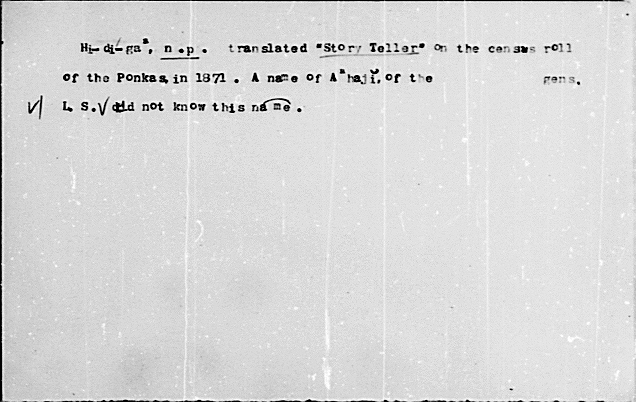
| Hi-dí-gaⁿ | Hidígoⁿ | prop.noun | Translated "Story Teller" on the census roll of the Ponkas in 1871. | 3/25/10 | 5/22/11, 4:34 PM | Catherine Rudin | http://omahalanguage.unl.edu/dictionary_images/hi/opd.02.046.01d.jpg |
View |
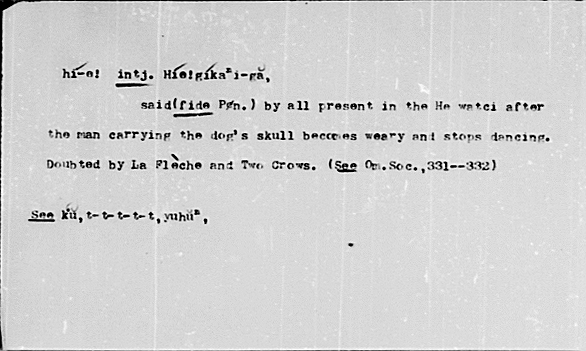
| hí-e | híe | Said by all present in the He watci after the man carrying the dog's skull becomes weary and stops dancing. | 3/25/10 | 12/22/10, 5:33 PM | Jacob Hilton | http://omahalanguage.unl.edu/dictionary_images/hi/opd.02.046.03b.jpg |
View | |
| Hí-ga-bú | Hígabú | prop.noun | A Kickapoo; the Kickapoos. | 3/25/10 | 12/22/10, 5:33 PM | Catherine Rudin | http://omahalanguage.unl.edu/dictionary_images/hi/opd.02.046.03d.jpg |
View |
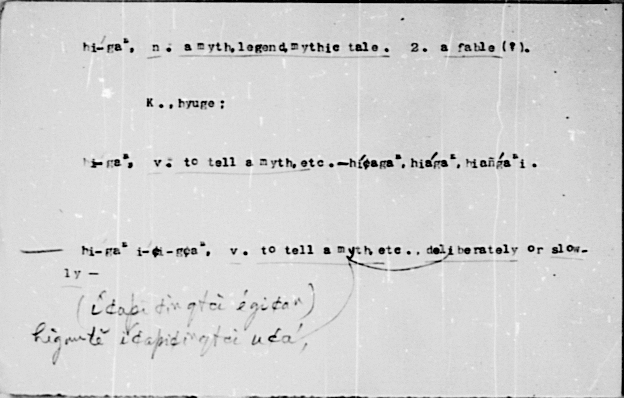
| hí-gaⁿ | hígoⁿ | n. | A myth, legend, mythic tale. 2. A fable (?). | 3/25/10 | 12/22/10, 5:33 PM | Catherine Rudin | http://omahalanguage.unl.edu/dictionary_images/hi/opd.02.046.04a.jpg |
View |
| hí-gaⁿ | hígoⁿ | v.a. | To tell a myth, etc. | 3/25/10 | 12/22/10, 5:33 PM | Catherine Rudin | http://omahalanguage.unl.edu/dictionary_images/hi/opd.02.046.04a.jpg |
View |
| hí-gaⁿ í-ȼi-gȼaⁿ | hígoⁿ íthigthoⁿ | v.phrase | To tell a myth, etc., deliberately or slowly. | 3/25/10 | 5/20/11, 5:17 PM | Catherine Rudin | http://omahalanguage.unl.edu/dictionary_images/hi/opd.02.046.04a.jpg |
View |
| hi-jú | hizhú | n. | The gums. | 3/25/10 | 12/22/10, 5:33 PM | Catherine Rudin | http://omahalanguage.unl.edu/dictionary_images/hi/opd.02.046.04c.jpg |
View |
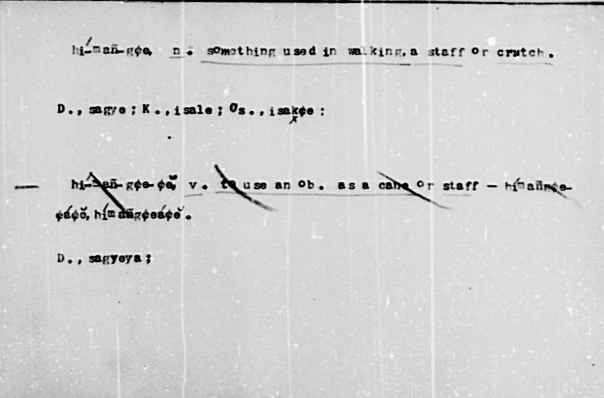
| hí-mañ-gȼa | hímoⁿgtha | n. | Something used in walking, a staff or crutch. | 3/25/10 | 12/22/10, 5:33 PM | Catherine Rudin | http://omahalanguage.unl.edu/dictionary_images/hi/opd.02.046.04d.jpg |
View |
| hí-mañ-gȼe-ȼĕ | hímoⁿgthethe | To use an object as a cane or staff. | 3/25/10 | 12/22/10, 5:33 PM | Jacob Hilton | http://omahalanguage.unl.edu/dictionary_images/hi/opd.02.046.04d.jpg |
View | |
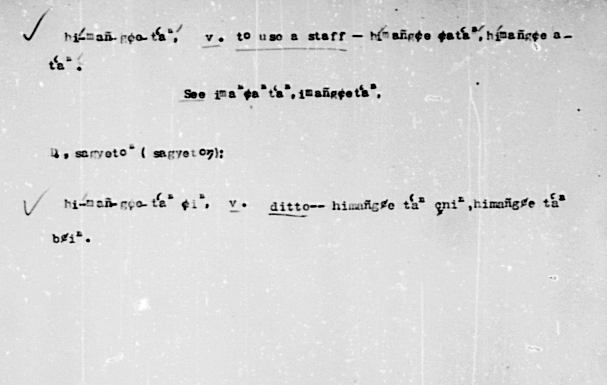
| hí-mañ-gȼe-t'áⁿ | hímoⁿgthetʰóⁿ | v.phrase | To use a staff. | 3/25/10 | 7/5/12, 8:25 PM | Catherine Rudin | http://omahalanguage.unl.edu/dictionary_images/hi/opd.02.046.05a.jpg |
View |
| hí-mañ-gȼe-t'aⁿ ȼiⁿ | hímoⁿgthetʰoⁿ thiⁿ | v.phrase | To use a staff. | 3/25/10 | 7/7/12, 11:45 PM | Catherine Rudin | http://omahalanguage.unl.edu/dictionary_images/hi/opd.02.046.05a.jpg |
View |
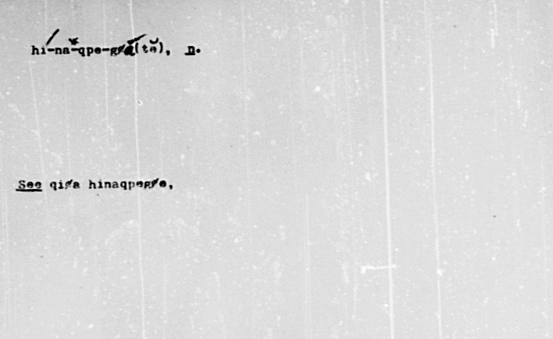
| hí-na-qpe-gȼá | hínaqpegthá | 3/25/10 | 12/22/10, 5:33 PM | Jacob Hilton | http://omahalanguage.unl.edu/dictionary_images/hi/opd.02.046.05b.jpg |
View | ||
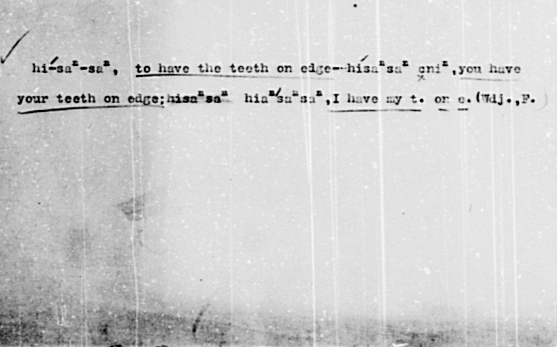
| hí-saⁿ-saⁿ | hísoⁿsoⁿ | v.s. | To have the teeth on edge. | 3/25/10 | 5/24/11, 3:08 AM | Catherine Rudin | http://omahalanguage.unl.edu/dictionary_images/hi/opd.02.046.05d.jpg |
View |
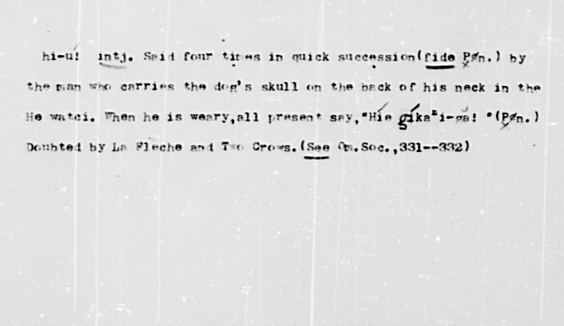
| hi-ú | hiú | Said four times in quick succession by the man who carries the dog's skull on the back of his neck in the He watci. | 3/25/10 | 12/22/10, 5:33 PM | Jacob Hilton | http://omahalanguage.unl.edu/dictionary_images/hi/opd.02.046.06c.jpg |
View |